
Learner 2- Session 2: Communicating with Influence under

 Task 2.2 – Facilitate Individual Learning Communicating with Influence.pdf




Leadership is more than authority, and communication is more than speech.
In every organisation, genuine leadership is defined by how clearly and credibly a person expresses their values. The great leaders of history—from Cyrus and Ashoka to Mandela and Ardern—understood that influence is not built on power, but on trust.
This article explores the art and science of communicating with influence: how leaders transform intention into impact, how values become visible through tone and behaviour, and why communication is the essential currency of credibility in modern business.
The Essence of Influence
In a business context, influence is the ability to inspire others to think, feel, or act differently through clarity, authenticity, and emotional intelligence. It cannot be ordered or delegated. It must be earned.
Influence rests on three essential pillars:
-
Credibility – People must believe you.
Credibility comes from consistency, reliability, and preparation. It is built slowly and lost quickly. -
Connection – People must feel understood.
Connection is the emotional bridge created through empathy, attentiveness, and shared purpose. -
Clarity – People must understand you.
Clear communication is concise, structured, and actionable.
The difference between communication and influence is the difference between being heard and being trusted. Great communicators do not speak to impress — they speak to clarify, unify, and move others toward meaningful action.
Aristotle’s Framework for Modern Leadership
The foundations of persuasive communication were laid more than two thousand years ago by Aristotle. His framework of Ethos, Pathos, and Logos still underpins every effective corporate communication strategy.
| Element | Definition | Business Application |
|---|---|---|
| Ethos | Credibility and integrity | Professional reputation and ethical conduct |
| Pathos | Emotional connection | Storytelling, empathy, and shared motivation |
| Logos | Logic and structure | Data, clarity, and evidence-based reasoning |
When a modern executive introduces a new strategic initiative, these elements are at play whether consciously or not.
-
Ethos builds trust through honesty and expertise.
-
Pathos engages emotions and creates a sense of shared journey.
-
Logos ensures logic, detail, and measurable goals.
Influential communication balances all three — trust, emotion, and reason — in equal measure.
The Unspoken Language of Influence
Words carry meaning, but tone and presence determine interpretation. Studies in organisational psychology show that most meaning in professional communication is conveyed non-verbally.
Posture, facial expression, and pacing convey credibility long before content is processed. A calm, grounded tone invites respect. A rushed or defensive tone projects anxiety and doubt. Even silence has value — a measured pause communicates confidence and gives the listener time to absorb information.
Great leaders manage not only their words but their energy. They understand that presence is not dominance; it is awareness — of timing, emotion, and audience readiness.
Leadership Under Pressure
Influence is tested in moments of uncertainty.
A leader’s language during organisational change, crisis, or public scrutiny determines whether stakeholders respond with trust or fear.
When communication is rushed, defensive, or vague, confidence collapses. When it is calm, transparent, and empathetic, credibility increases — even if the news itself is difficult.
The modern corporate leader is a stabilising force. Their tone becomes the emotional climate of the organisation. Their words shape morale, retention, and loyalty.
The Modern Sword of Damocles
The ancient Greek story of Damocles describes a courtier who envies a king’s wealth until he is allowed to sit on the throne — beneath a sword suspended by a single horsehair. In that moment, Damocles realises that power carries constant risk.
Every leader sits beneath their own modern sword:
-
Performance metrics
-
Market competition
-
Ethical accountability
-
Team wellbeing
Integrity is the thread that holds the sword in place. When that thread frays, the organisation’s stability falters.
Leadership influence is not measured by escaping pressure but by how confidently and ethically one communicates beneath it.
The Structure of Persuasive Communication
Influence requires discipline. The elevator message technique helps leaders articulate purpose, value, and action in under a minute — a vital skill in fast-moving workplaces.
Structure:
-
Purpose – What you want to achieve.
-
Value – Why it matters to the listener.
-
Action – What you want them to do next.
Example:
“I’d like to recommend updating our customer onboarding process. It could reduce wait times by 30% and improve satisfaction. Could I present a short proposal next week?”
This clarity converts good ideas into opportunities for engagement. Brevity signals confidence; structure builds respect.
Emotional Intelligence and Authentic Communication
Values and communication cannot be separated.
A leader who declares transparency but conceals mistakes erodes credibility.
A leader who acknowledges error, explains their reasoning, and acts with accountability strengthens trust.
Emotional intelligence — the capacity to read context, regulate tone, and empathise authentically — transforms technical information into human connection.
The emotionally intelligent communicator anticipates reactions before they happen, frames messages around shared goals, and listens as actively as they speak.
Integrity and Alignment
Influence without integrity is manipulation. Integrity without communication is invisibility. The true leader’s power lies at the intersection of the two: communicating authentically and behaving consistently.
When internal values and external words align, teams develop psychological safety. Staff mirror what they see; when they hear truth and respect, they respond with engagement and accountability.
This alignment also protects brand credibility. Every customer service interaction, every board presentation, and every meeting becomes a reflection of the organisation’s integrity.
Feedback as a Leadership Skill
Influence also depends on the ability to guide others with clarity and respect. Traditional feedback often centres on criticism; feedforward centres on growth.
A simple model is:
-
Describe the behaviour: “In yesterday’s meeting, you spoke passionately.”
-
Describe the impact: “That energy captured the team’s attention.”
-
Offer improvement: “Next time, pause slightly before your key point to let it land.”
This approach builds confidence and accountability simultaneously. It treats communication as a skill to be developed, not a flaw to be corrected.
Great communicators turn feedback sessions into trust-building conversations.
Reflection and Continuous Growth
Influential communication develops through reflection and deliberate practice.
Effective leaders routinely ask themselves:
-
Did my tone match my intention?
-
Did my message reflect our organisation’s values?
-
Did my audience leave clearer and more confident than before?
Self-awareness strengthens influence. The more leaders examine how they speak and how they are perceived, the more agile and credible they become.
Reflection is not an act of doubt; it is an act of discipline — the quiet recalibration that sustains leadership integrity.
Building a Culture of Communication
Influence multiplies when modelled. A single leader who demonstrates clarity, empathy, and composure under pressure sets the tone for the entire organisation. Over time, these behaviours become cultural norms — reflected in meetings, client calls, and internal communication systems.
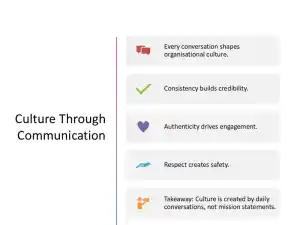
Organisational culture is not defined by mission statements; it is shaped by conversation. Every interaction either reinforces or erodes the culture a leader intends to build.
Action Plan: Strengthening Leadership Communication
-
Start doing: Pause before responding; use silence to signal thoughtfulness.
-
Stop doing: Using qualifiers like “maybe” or “I think” when certainty is needed.
-
Continue doing: Linking all communication to shared purpose and measurable outcomes.
Influence develops through these small, habitual refinements. Over time, they form the leader’s professional voice and legacy.
From Voice to Legacy
From the stoic emperors of Rome to the empathetic prime ministers of today, the principle has never changed: leadership is communication, and communication is character.
Every boardroom, staff meeting, and client interaction is a reflection of leadership maturity.
Clarity creates confidence. Compassion builds connection. Consistency earns credibility.
Influence is not the volume of your voice — it is the alignment between what you say and who you are.