
Learner 1 Session 1: Leadership and Organisational Values
 Leadership_and_Organisational_Values_Session1_Presentation.pdf




Leadership has never been about titles or hierarchies. It has always been about purpose. Whether in the courts of ancient kings or the boardrooms of modern corporations, the measure of leadership remains unchanged — it is the alignment between what one believes, what one says, and what one does.
This long-form article explores the foundations of values-based leadership as introduced in the Certificate IV in Leadership and Management (BSB40520). Drawing from history, literature, philosophy, and modern business practice, it demonstrates how ethics, empathy, and integrity remain the bedrock of authentic organisational influence.
The Timeless Nature of Leadership
“Leadership is not about power; it’s about purpose.”
From the ancient empires of Persia and India to the innovation hubs of today’s multinational corporations, leaders who endure across generations share common values: integrity, courage, fairness, compassion, and vision. These traits transcend geography, culture, and industry. They are not taught through instruction but remembered through example.
Leadership is the daily act of modelling the behaviour you wish to see in others. It is purpose expressed as practice.
Leadership Through the Ages
History provides countless case studies of leaders who understood that governance without values fails.
Cyrus the Great (Persia, 550 BC) demonstrated inclusion and fairness, uniting a vast empire through tolerance and justice — principles mirrored today in workplace diversity and equity frameworks.
Ashoka the Great (India, 250 BC) transformed from conqueror to moral statesman, choosing compassion and welfare over domination. His journey mirrors the modern corporate shift from profit to purpose, from shareholder value to stakeholder wellbeing.
Marcus Aurelius (Rome, 161 AD) exemplified integrity and self-reflection through his Meditations, reminding modern leaders that ethical leadership begins with introspection.
Wu Zetian (China, 690 AD) broke tradition by rewarding merit over lineage, pioneering what today’s leaders call performance-based progression and talent equity.
Queen Elizabeth I (England, 1558) reigned with strategic communication and decisiveness, skills that remain vital to executive leadership and stakeholder management.
The early lessons in human resources, change management, and governance were written not in corporate policy, but in the actions of these rulers. Their empires fell, yet their examples endure.
From Monarchs to Managers
The principles of great leadership are ageless.
-
Lead with values, not position. Authority demands compliance; values earn commitment.
-
Reward merit, not popularity. Integrity builds trust in systems and teams.
-
Reflect before reacting. Every decision is a mirror of leadership maturity.
-
Balance empathy with authority. Strength without compassion is feared, not followed.
These timeless traits underpin the most effective modern managers. The difference is not in the values themselves but in the context — where once a crown signified rule, today a manager’s credibility is defined by their behaviour.
Shakespeare’s Leaders: The Human Side of Power
No one captured the psychology of leadership better than Shakespeare. His monarchs and generals still serve as allegories for corporate behaviour today.
“Uneasy lies the head that wears a crown.” – Henry IV
“To thine own self be true.” – Hamlet
Shakespeare’s Julius Caesar warns of ambition without integrity. King Lear exposes the ruin caused by pride and poor listening. Henry V celebrates shared purpose and servant leadership.
These are not stories of royalty alone — they are parables of workplace leadership, reminding us that communication, empathy, and humility remain the antidotes to ego. Every meeting, every project, and every decision is a scene in which the leader’s credibility is performed and perceived.
The Sword of Damocles: The Weight of Responsibility
The ancient Greek parable of Damocles captures the truth that leadership carries constant pressure. When Dionysius the tyrant allows his courtier to sit upon the throne, Damocles sees the splendour of power — until he notices a sword hanging by a single horsehair above his head.
In the modern workplace, every leader sits beneath their own sword:
-
Deadlines that threaten morale
-
Compliance obligations that demand precision
-
Ethical responsibilities that require courage
The lesson is simple: leadership’s privilege is inseparable from its pressure. True leaders act not from fear of the sword but from respect for the trust it symbolises. Integrity, transparency, and calm under pressure are the invisible threads that hold the sword aloft.
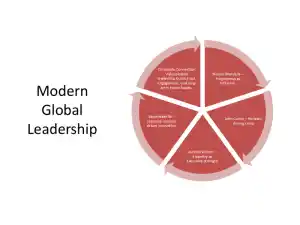
Modern Global Leadership: Values in Motion
Contemporary leaders across the globe continue to illustrate the universality of values-based leadership.
Nelson Mandela turned forgiveness into strategy, proving that reconciliation can rebuild nations — or, in business, restore fractured teams.
John Curtin, Australia’s wartime Prime Minister, modelled honesty during crisis, prioritising truth over popularity.
Jacinda Ardern reframed empathy as a strength, leading with compassion through adversity.
Satya Nadella, the CEO of Microsoft, replaced a culture of arrogance with one of curiosity — transforming the company by encouraging a learn-it-all rather than know-it-all mindset.
Each of these leaders understood that influence is built through credibility and service, not control.
The Values-to-Behaviour Chain
Values are not abstract ideals. They are operational blueprints.
-
Values – The foundation of leadership decisions.
-
Decisions – The bridge between belief and behaviour.
-
Actions – Values made visible through conduct.
-
Culture – Repeated behaviour becomes collective habit.
-
Reputation – The external reflection of internal consistency.
When a leader’s actions reflect their stated values, credibility and performance rise. When they diverge, trust erodes silently but swiftly.
Organisational Values in Action
Most organisations articulate their values — Integrity, Respect, Accountability, Teamwork, Excellence. The challenge is living them.
Values only matter when they influence daily operations.
-
Embed them in policies and key performance indicators.
-
Model them consistently, especially under stress.
-
Recognise value-driven behaviour in others.
-
Reinforce them through decision-making and communication.
The strongest cultures are not built through slogans but through leaders who consistently act on principle, even when the cost is high.
Reflection: Aligning the Personal and the Organisational
The leader’s role begins with self-awareness.
Identify your top three personal values and compare them with your organisation’s stated values.
Do they align or conflict?
If they align, you will lead naturally and with authenticity.
If they conflict, your influence will always feel divided.
Alignment between personal belief and corporate purpose transforms compliance into conviction. It is the difference between managing people and inspiring them.
Scenario in Practice: Values Under Pressure
A project deadline is missed, and a client’s trust is at risk. How does a leader respond while maintaining integrity?
-
Stay calm and acknowledge facts. Avoid blame; focus on reality.
-
Demonstrate accountability. Accept responsibility without defensiveness.
-
Communicate with respect. Transparency builds credibility faster than spin.
-
Focus on solution and prevention. Leadership is problem-solving under observation.
In this scenario, professionalism is not tested by the mistake itself but by the honesty and composure of the response.
Reflection and Commitment
At the conclusion of every leadership session, reflection cements learning into habit.
Ask yourself:
-
Which leader’s example resonates most with my own aspirations?
-
What value will I consciously model this month?
-
How will I measure success beyond results — in trust, collaboration, and morale?
Booker T. Washington summarised it perfectly:
“Character is power.”
Character amplifies competence. It determines whether communication inspires or alienates, whether authority is respected or resented.
The Leadership Legacy
From the palaces of ancient rulers to the modern corporate boardroom, the formula for sustainable leadership remains constant:
-
Lead with vision. Define purpose before action.
-
Act with integrity. Do what’s right, not what’s easy.
-
Communicate with empathy. Listen as much as you lead.
-
Reflect often. Growth is rooted in self-awareness.
Leadership is not an event. It is a continuous conversation between principles and practice, between personal conviction and collective responsibility.
Whether one manages a team of five or leads a global enterprise, the same truth applies: leadership without values is management without meaning.
Closing Reflection
The world’s great leaders — from ancient kings to modern executives — understood that every act of leadership is a moral act. Values do not decorate a company’s website; they define its decisions.
When values guide leadership, culture thrives. When culture thrives, performance follows naturally.
Lead with vision. Act with integrity. Communicate with conscience. Reflect with humility.
Learner 1 Session 1 Quiz 1– Leadership and Organisational Values
Learner 1 Session 1 Quiz 2– Leadership and Organisational Values
Further Reading.pdf