
Understanding the Australian Student Visa (Subclass 500)




The Australian Student Visa (Subclass 500): A Comprehensive Explanation for International Students
I explain the Student visa (subclass 500) as the central legal framework through which international students are permitted to study in Australia. It is a carefully regulated temporary visa created for a specific and limited purpose: education. Every right it grants, every condition it imposes, and every decision made by the Department of Home Affairs is assessed against that single organising principle.
What follows is a complete and student-focused explanation of how the subclass 500 visa operates, what it allows, what it requires, and how to remain compliant throughout your stay in Australia. I present this explanation in clear, structured terms so that you can understand both the opportunities the visa provides and the responsibilities it imposes
.
A. The Purpose and Nature of the Student Visa
-
The Student visa (subclass 500) is a temporary visa that allows non-citizens to enter and remain in Australia for the primary purpose of undertaking a genuine course of study
-
It applies across all recognised education sectors, including:
(a) primary and secondary schooling
(b) English Language Intensive Courses for Overseas Students (ELICOS)
(c) foundation and pathway programs
(d) vocational education and training (VET)
(e) higher education coursework
(f) postgraduate research -
The visa does not exist to facilitate work, migration, or long-term residence. Any work rights or incidental benefits exist only to support study, not to replace it
-
The maximum length of stay is generally determined by the duration of your enrolled course or packaged courses, subject to an overall limit of six years, with shorter limits applying to certain school students
B. What the Student Visa Allows You to Do
-
With a granted Student visa, you may lawfully:
(a) study full-time in a CRICOS-registered course
(b) travel in and out of Australia as many times as you wish while the visa is valid
(c) work up to 48 hours per fortnight while your course is in session -
During official course breaks, you may work unlimited hours
-
If you are studying a master’s degree by research or a doctoral degree, the 48-hour work limitation does not apply to you or your accompanying family members
-
Time spent outside Australia does not extend the validity of your visa
-
Your visa is digitally linked to your passport. There is no physical visa label
C. Confirmation of Enrolment and Course Requirements
-
A valid Confirmation of Enrolment (CoE) is the legal foundation of a Student visa application
-
You must be enrolled in a full-time course registered on the Commonwealth Register of Institutions and Courses for Overseas Students (CRICOS)
-
A Student visa application lodged without a CoE is invalid and cannot be processed
-
Your CoE must remain valid at the time the Department makes a decision on your application. If it is cancelled or completed, you must upload a new CoE to remain eligible
-
You may include packaged courses in a single visa application where one course clearly leads to the next, provided course gaps are limited and justified
D. Age and Welfare Requirements
-
If you are applying as a school student, strict age limits apply based on the year level you intend to commence
-
If you are under 18 years of age, you must have approved welfare arrangements in place for your stay in Australia or until you turn 18, whichever occurs first
-
Welfare arrangements may include:
(a) confirmation of appropriate accommodation and welfare from an education provider
(b) nomination of an eligible guardian
(c) approved exchange or government sponsorship arrangements -
Consent from parents or legal guardians is mandatory and must be supported by formal documentation
E. Overseas Student Health Cover (OSHC)
-
You and any accompanying family members must maintain Overseas Student Health Cover (OSHC) for the entire duration of your stay in Australia unless an exemption applies
-
OSHC must commence from the date you arrive in Australia, not merely from the start date of your course
-
If there is any gap in health insurance coverage, your visa may be refused or cancelled
-
Proof of OSHC is mandatory at the time of application. Failure to provide accurate OSHC details results in refusal
F. English Language Requirements
-
You may be required to provide evidence of English language proficiency unless you fall within a recognised exemption category
-
Only English tests approved by the Department of Home Affairs are accepted, and strict rules apply regarding:
(a) minimum scores
(b) test validity periods
(c) acceptable delivery formats -
Entirely online or at-home English language tests are not accepted for visa purposes
-
Different score thresholds apply depending on whether your course is standalone or packaged with ELICOS or a pathway program
G. The Genuine Student Requirement
-
The Genuine Student requirement is central to every Student visa decision
-
You must demonstrate that studying in Australia is your primary intention and that your personal, academic, and financial circumstances support that intention
-
The Department assesses:
(a) your education history
(b) employment background
(c) financial position
(d) immigration history
(e) future plans after study -
You must respond to structured questions in your online application. These responses carry significant legal weight and must be coherent, truthful, and consistent with supporting documents
H. Financial Capacity
-
You must demonstrate that you have sufficient funds to cover:
(a) travel costs
(b) tuition fees
(c) living expenses
(d) schooling costs for dependent children, where applicable -
The financial amounts specified by the Department represent minimum thresholds only and do not reflect the true cost of living in many Australian cities
-
Evidence of funds may include:
(a) personal savings
(b) parental or partner income
(c) education loans
(d) scholarships or government sponsorship -
Where funds are provided by another person, you must demonstrate both the source of the funds and your genuine access to them
-
You should not rely on employment in Australia to meet basic living costs. Work rights are supplementary and legally restricted
I. Health, Character, and Values Obligations
-
You must meet Australian health and character requirements, which may include medical examinations and police certificates
-
Applicants aged 18 or over must sign the Australian Values Statement, confirming respect for Australian laws and democratic principles
-
Failure to meet health or character requirements can result in refusal regardless of academic merit or financial capacity
J. Application Process
-
All Student visa applications must be lodged online through ImmiAccount
-
You may apply from inside or outside Australia, subject to restrictions based on your current visa status
-
A valid application requires payment of the correct visa application charge unless a lawful exemption applies
-
Providing false, misleading, or incomplete information can lead to refusal, cancellation, and long-term migration consequences
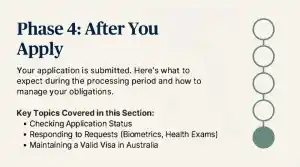
K. After Lodgement
-
After you apply, you must:
(a) monitor ImmiAccount regularly
(b) respond promptly to requests for further information
(c) attend biometrics or health examinations if requested -
If you apply while in Australia, you may be granted a Bridging visa that allows you to remain lawfully while a decision is made
-
Travel on a Bridging visa generally requires separate permission
L. Obligations After Grant
-
Once your Student visa is granted, you must:
(a) remain enrolled in a full-time course
(b) maintain satisfactory academic progress and attendance
(c) comply with work limitations
(d) maintain OSHC
(e) notify the Department of changes to your circumstances -
If your study situation changes, including course changes or early completion, specific notification and approval requirements may apply
M. Staying Longer and Visa Expiry
-
The Student visa cannot be extended
-
To continue studying, you must apply for a new Student visa before your current visa expires
-
If your visa expires before graduation, you may need to apply for a different visa supported by formal documentation from your education provider
N. Concluding Observations
-
The Student visa (subclass 500) is a detailed and carefully regulated legal instrument
-
Its benefits are significant, but they are conditional on sustained compliance with Australian migration law
-
When approached with clarity, honesty, and procedural discipline, the visa provides a stable and lawful pathway to study, work within limits, and live temporarily in Australia
-
The most important principle to understand is this: study is not one condition of the visa; it is the legal reason the visa exists. Every entitlement flows from that premise, and every risk arises when it is undermined
 Subclass 500 Student visa.pdf